Essentials
A visual primer for American Mah Jongg
Every tile at a glance, plus the language of the card, colors, suits, and the building blocks of every hand. A friendly place to start before you sit down to play.
Tile basics
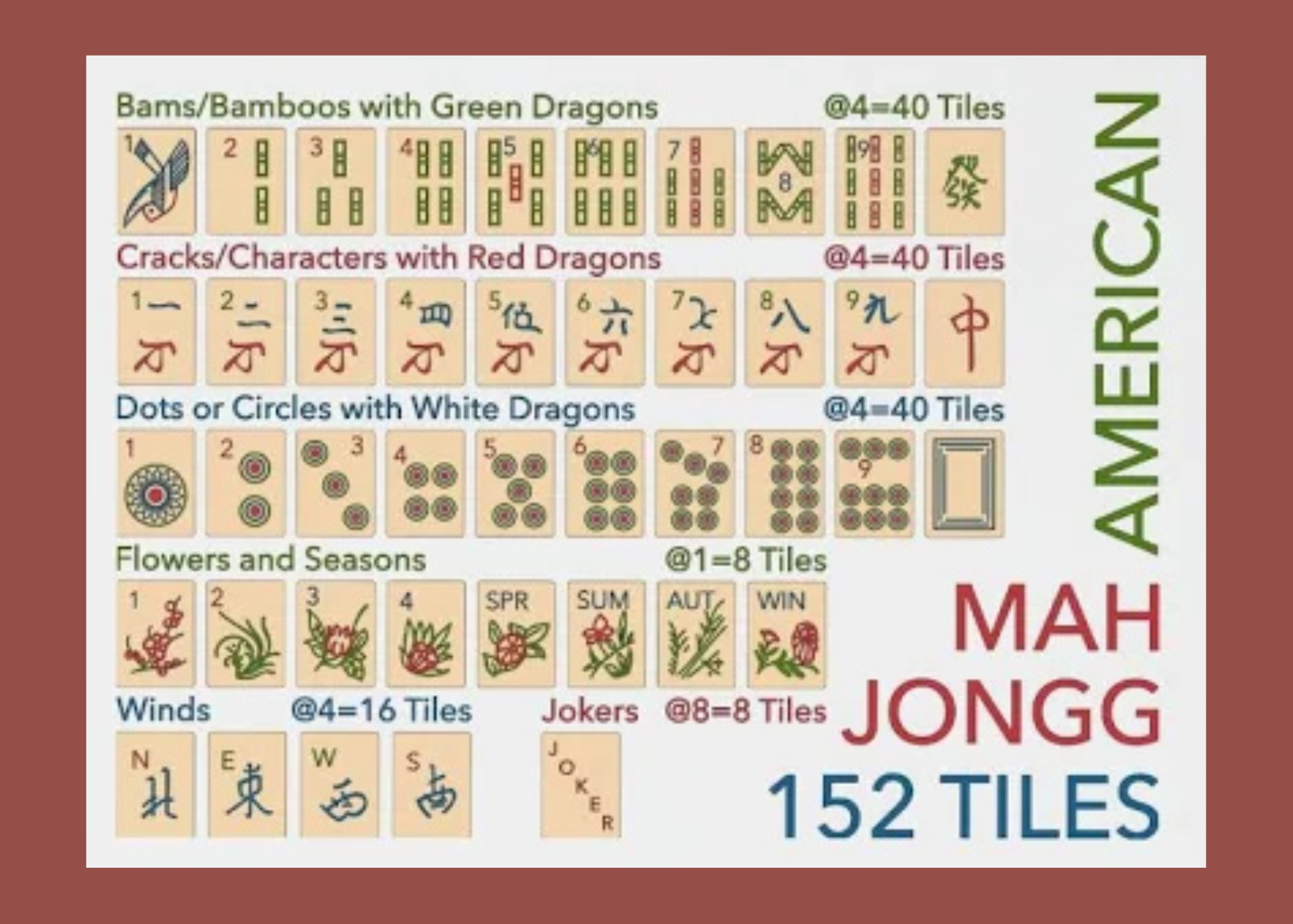
152 tiles, six families
A full American Mah Jongg set has 152 tiles. Once you can name the families, the rest of the game starts to fall into place.
Bams (Bamboos)
40 tilesNumbered 1–9, four of each. The 1 Bam is the bird. Paired on the card with the Green Dragon.
Cracks (Characters)
40 tilesNumbered 1–9, four of each, with Chinese character markings. Paired with the Red Dragon.
Dots (Circles)
40 tilesNumbered 1–9, four of each. Paired with the White Dragon (the framed blank/'soap').
Winds
16 tilesNorth, East, West, South, four of each. Used in the Winds–Dragons section and a few specialty hands.
Flowers & Seasons
8 tilesEight Flower tiles total. The card treats them as interchangeable Flowers, no need to match the picture.
Jokers
8 tilesWildcards. Powerful, but with strict rules about where they can and can't be used (see below).
Reading the card
What the three colors mean
The National Mah Jongg League card uses three ink colors to tell you which suits go together. Each color is a slot, pick a suit family for that color and stick with it across the whole hand.
One suit family. Most often used as Bams (with the Green Dragon when dragons appear).
A different suit family. Often used as Cracks (with the Red Dragon).
A third suit family, distinct from the other two. Often used as Dots (with the White Dragon).
The vocabulary
Singles, pairs, pungs, kongs & more
Every hand on the card is made up of small groupings of identical tiles. The card shows them in a row, once you know the words, you can read any hand.
Single
One tile, all by itself. Common in the Singles & Pairs section.
Pair
Two identical tiles.
Pung
Three identical tiles.
Kong
Four identical tiles.
Quint
Five identical tiles, only possible because of jokers.
Sextet
Six identical tiles. Rare, and only on hands designed for them.
The card
All nine sections, explained
The 2026 National Mahjongg League (NMJL) card features 72 printed hands across 9 distinct categories. Due to the various suit options and wild-card variables, there are over 1,000 possible winning combinations available to play. Knowing the headers helps you choose a hand quickly and recognize what others might be playing.
2026
Hands built around the current year's number. The digits 2, 0, 2 and 6 appear as suit tiles, winds, or jokers depending on the hand.
2468
Even-number hands. Every numbered tile in the hand is 2, 4, 6, or 8, across one, two, or three suits.
Any Like Numbers
Pick any one number, 1 through 9, and build the hand from that single number across the suits.
Quints
Hands that require groups of five, only buildable with jokers in pungs and kongs of the same tile.
Consecutive Run
A sequence of consecutive numbers (for example 3-4-5-6-7). You choose where the run starts.
13579
Odd-number hands. Mirror of 2468, every numbered tile is 1, 3, 5, 7, or 9.
Winds–Dragons
Hands built mostly from winds (N, E, W, S) and dragons (Green, Red, White), with little or no numbered suit tiles.
369
Hands built only from the numbers 3, 6, and 9.
Singles and Pairs
The hardest section: every tile is a single or a pair, no pungs or kongs. Jokers are not allowed here.
Wildcards, with rules
Joker basics
Jokers are powerful, but they don't go anywhere. Learn what they can and can't do and you'll avoid the most common beginner mistakes.
Jokers CAN
- • Stand in for any tile inside a pung, kong, quint, or sextet
- • Be used anywhere a group of three or more identical tiles is required
- • Be redeemed (swapped) from another player's exposure if you hold the real tile
Jokers CAN'T
- • Be used as a single or in a pair
- • Be used anywhere in the Singles & Pairs section
- • Be redeemed from a player's own exposure, or swapped for another joker
Ready to learn from a person, not a page?
The card makes a lot more sense across a table with tiles in your hands. That's where lessons come in.