
FAQs
Mah Jongg FAQs for Beginners
New to Mah Jongg? Start Here.
Learning American Mah Jongg can feel like learning a new language. There are tiles, jokers, the Charleston, directions, exposures, and a card that may look overwhelming at first glance. The good news? Every experienced player was once a beginner staring at a rack of tiles, wondering what to do next.
The fastest way to become comfortable at the table is to understand a handful of key concepts before you play. These frequently asked questions cover the rules, strategies, and etiquette that confuse beginners most often. Read through them, keep the memory tips in mind during your next game, and you'll spend less time feeling overwhelmed and more time enjoying the fun, social, and strategic challenge that makes Mah Jongg so rewarding.
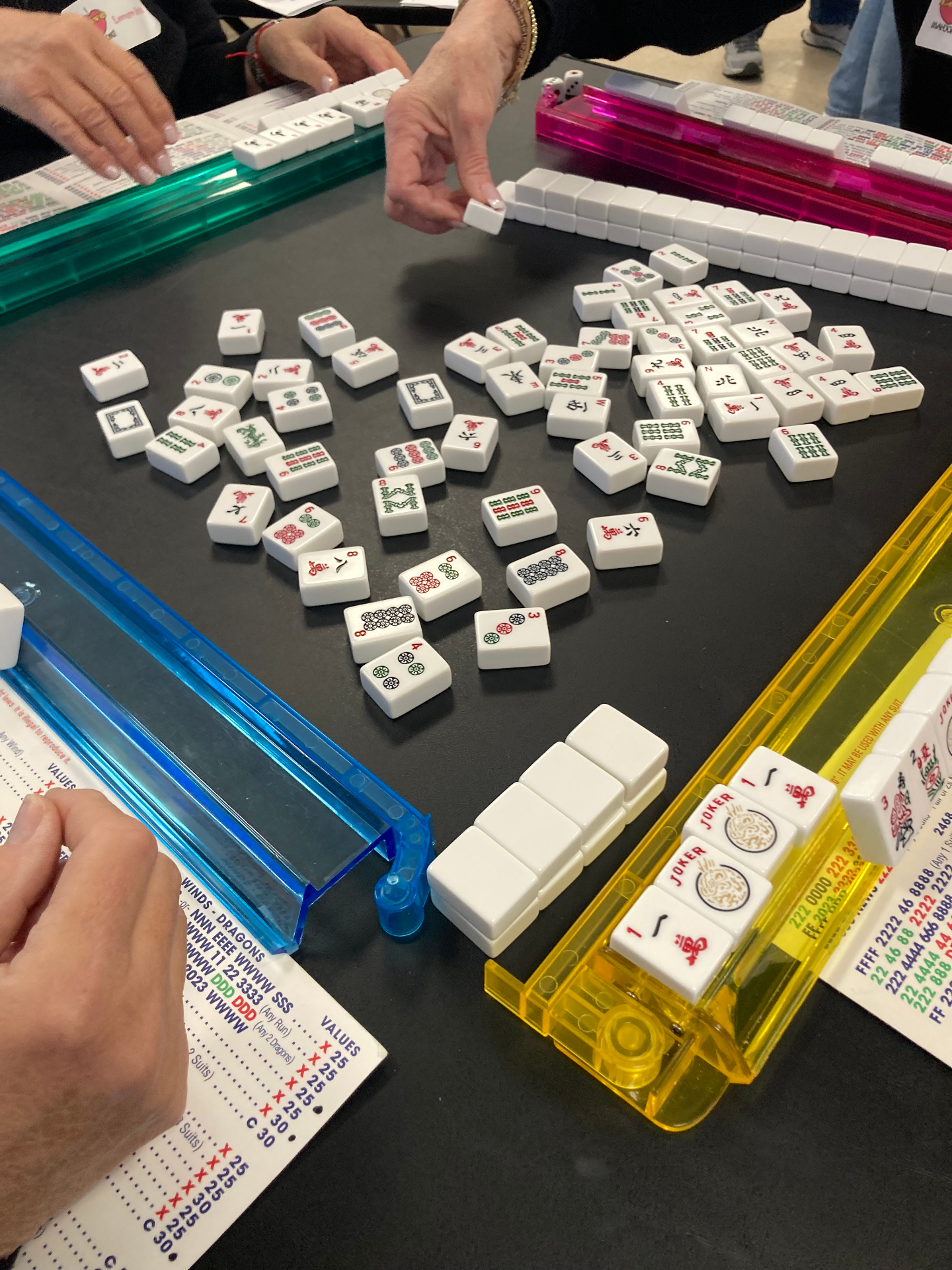
Understanding the Basics
1. What is the goal of Mah Jongg?
The goal is to complete a hand that exactly matches one of the combinations listed on the current National Mah Jongg League (NMJL) card. Your hand must contain 14 tiles arranged exactly as shown.
Memory Tip: You're building one of the 72 hands across 9 distinct categories printed on the card.
2. When should I choose my hand?
As early as possible. After the Charleston and your first few picks, begin narrowing your options to two or three possible hands.
Memory Tip: New players often try to keep every possibility open. That usually leads to a hand that doesn't come together. Choose a direction and commit.
3. What is the biggest mistake beginners make?
Changing hands too often.
New players frequently switch directions every time they pick a useful tile. Strong players commit to a hand and make strategic adjustments only when necessary.
Memory Tip: Don't chase every shiny tile.
The Charleston & Game Setup
4. What is the Charleston?
The Charleston is the tile-passing phase at the beginning of the game. Players pass unwanted tiles and receive new ones before regular play begins.
Think of it as cleaning out your closet. You're getting rid of what doesn't fit and collecting what might.
5. How do I remember the Charleston directions?
Use the word ROLLOR:
- Right
- Over (across)
- Left
- Left
- Over (across)
- Right
Many players find this easier than memorizing the directions individually.
6. Why do we break the wall?
After the tiles are shuffled and built into walls, East rolls the dice to determine where the wall will be broken. Breaking the wall creates the starting point for dealing and ensures randomness.
Memory Tip: The dice tell you where the game begins.
7. What does it mean to be East?
East is the dealer and starts the game. East rolls the dice, breaks the wall, receives tiles first, and makes the first discard.
Memory Tip: East is the host of the game.
8. Who plays after East?
Play proceeds counterclockwise, meaning the player sitting to East's right takes the next turn.
Memory Tip: East starts. Right goes next.
9. Why do we push the walls to the left?
Before the wall is broken, players push their walls to the left to form the square used for the deal.
Memory Tip: Push left. Deal right.
Calling, Exposing & Concealed Hands
10. Can I call a discarded tile?
Yes, if the discarded tile helps complete an exposure or Mah Jongg.
Before calling, make sure the tile truly fits your chosen hand.
11. What is an exposed hand?
An exposed hand contains one or more sets that have been called from another player's discard and placed face up on your rack.
Once exposed, other players gain information about your hand.
12. What is a concealed (closed) hand?
A concealed hand is completed entirely from tiles you draw yourself without calling discards.
Many NMJL hands specifically require the hand to remain concealed.
13. How do I know if a hand is concealed?
The NMJL card will specifically say "Concealed Hand."
If it says concealed, every tile must come from your own picks and draws.
Memory Tip: If the card says concealed, keep your hands to yourself.
House Rules
14. What are house rules?
House rules are optional variations used by a particular group. They are not official National Mah Jongg League rules.
Examples may include:
- Special jackpots
- Alternative scoring methods
- Modified Charleston procedures
- Local table customs
Before the game begins, ask if the group uses any house rules.
Memory Tip: The NMJL card and rulebook are the official rules. Anything added by the table is a house rule.
Mah Jongg Etiquette: How to Be a Great Tablemate
Mah Jongg is a social game. Good etiquette helps everyone enjoy the experience and keeps the game moving smoothly.
Use the correct table language.
Certain words have specific meanings:
- Say "Wait" or "Hold" if you need a moment to determine whether you can use a discarded tile.
- Say "Call" when you want to claim a discarded tile.
- Say "Exchange" when exchanging a tile for a joker in an exposed set.
Memory Tip: PET = Pick. Exchange. Throw
Never touch another player's rack.
Each player is responsible for managing their own tiles.
Even when helping a beginner, avoid reaching for, moving, pointing at, or rearranging another player's tiles unless specifically invited to do so.
Don't touch someone else's exposure or Joker.
If you are exchanging for a joker, announce "Exchange" and allow the owner of the exposure to complete the exchange.
Tip: If it isn't your rack, your exposure, or your joker, don't touch it.
Call a discard clearly and promptly.
If you need a discarded tile, speak up immediately.
Waiting too long can create confusion.
Pay attention when it's not your turn.
Stay engaged so the game moves smoothly.
Watching discards and exposures is also one of the best ways to improve your strategy.
Verify before exposing.
Before exposing a pung, kong, quint, or sextet, take an extra second to make sure it fits your chosen hand.
Memory Tip: Pause before you expose.
Avoid coaching during a hand.
Unless the table has agreed to teaching play, avoid telling another player what they should discard or what hand they should pursue.
Save strategy discussions for after the game.
Announce "Mah Jongg!" clearly.
When you complete your hand, say "Mah Jongg!" confidently so all players know the game has ended.
You earned it!
Be gracious.
Some days the tiles cooperate. Some days they don't.
The players everyone wants to invite back aren't always the strongest; they're the most enjoyable people to sit with around the table.
Beginner Cheat Sheet
Keep these phrases in mind, and you'll avoid many of the most common beginner mistakes:
- ✓ Push Left. Deal Right.
- ✓ East Starts. Right Goes Next.
- ✓ ROLLOR (Right, Over, Left, Left, Over, Right)
- ✓ Jokers Join Groups.
- ✓ No Joker Alone. No Joker Pair.
- ✓ No Joker Zone (for clustered singles)
- ✓ Pause Before You Expose.
- ✓ Pick. Exchange. Throw
Master these simple reminders, and you'll quickly build confidence, understand the flow of the game, and become a welcome player at any Mah Jongg table.
Still have questions?
The best way to learn is across a table with tiles in your hands.